
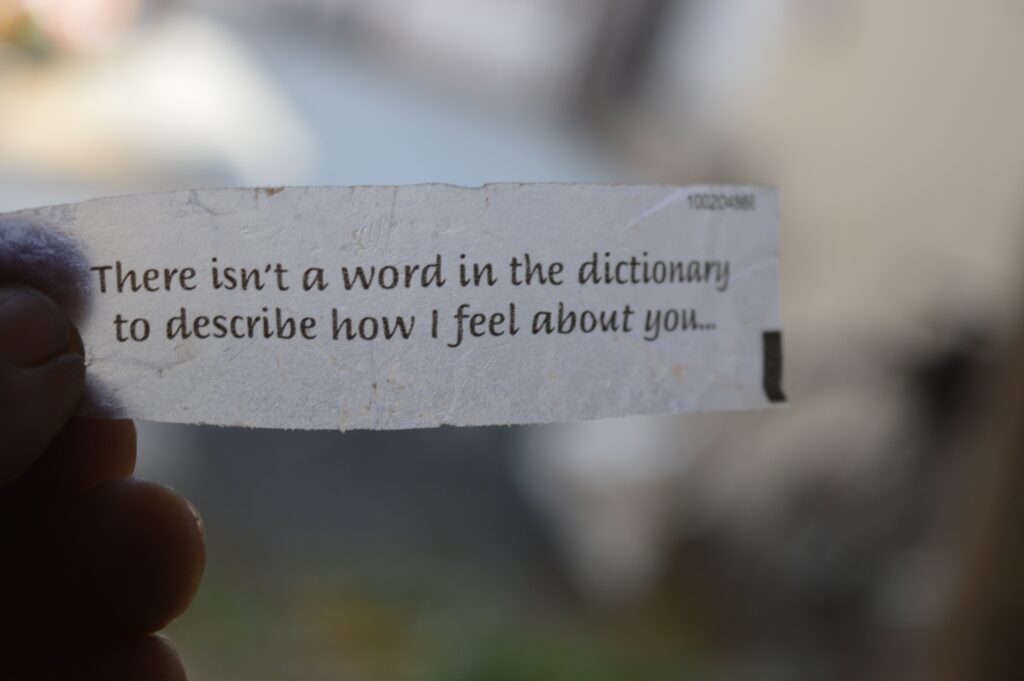
Look at the photo. Is this an example of sentiment or melodrama? Read on to get clues.
In my sportswriting career, I often wrote in-depth, human-interest stories about athletes who overcame great adversity to star in their sport. Whether it was a college softball player who went with her mother to cocaine dens to get her next fix, a high school softball player whose pursuit of perfection made her extremely difficult to be around (despite her incredible talent and work ethic), or a prep soccer player who had to live with himself after crashing his car and putting his friend in a coma, these stories were incredible rewarding, and they were the seeds of my eventual ghostwriting career.
They also were incredibly emotional, to write and to read. I learned early on that the key to these types of stories is to simply describe what the person saw, heard, felt, tasted, and touched.
Instead of saying the person was sad, I would describe the tears or the body trembles. I asked a lot of who/what/where/when/how/why questions to get more details. I varied the paragraphs, alternating between longer, complex sentences that placed the reader at the scene with short, choppy, dramatic sentences that packed heavy emotion, dramatic turns, or ironic twists.
No cliches, no flowery language. Just the (sometimes) gory details.
I still do this in my ghostwriting career, especially when I’m writing and editing memoirs. Recently, I’ve had some clients want me to use ChatGPT or Claude to flesh out stories.
What I’ve discovered is that AI doesn’t know the difference between sentiment and melodrama.
Sentiment refers to genuine emotion; melodrama is exaggerated. Sentiment is often tender; melodrama is sensationalized. Sentiment appeals to one’s feelings; melodrama lets plot take precedence over characterization to force an emotional response. Sentiment is sincere; melodrama is manipulative.
To use movies as examples, sentiment is “Forrest Gump” and “E.T. the Extra-Terrestrial.” Melodrama is “Gone with the Wind” and “Titanic.”
In my (seemingly) ongoing series about writing better than AI can, it is critical that a professional ghostwriter knows how to write sentimentally instead of melodramatically.
Here are twelve ways to spot melodrama.
1. The grief is theatrical instead of specific.
Sentiment: “When my father died, I kept reaching for the phone to call him.”
Melodrama: “The universe itself collapsed into unbearable darkness, and every breath became agony.”
Sentiment trusts the reader to feel the loss through the recognizable action, one universal enough for many of us to understand and possibly have done. The second overstates the emotion and uses far too many unnecessary words, leaving the impression that breathing is performed instead of lived.
2. The emotion is overexplained.
Sentiment: “She folded the hospital bracelet into her purse and never mentioned the diagnosis again.”
Melodrama: “This proved how deeply broken and tragically wounded she truly was inside.”
The sentimental sentence lets readers infer emotion, which depending on the context might be denial, resignation, fear, or shame. The melodramatic sentence explains the emotion so aggressively that it removes subtlety. Again, the context will reveal if the emotion is sadness, shame, fear, hopelessness, loneliness, or bitterness, but it’s so over the top that it beats the reader over the head.
3. Ordinary hardship is not cosmic tragedy.
Sentiment: “Losing the business embarrassed him more than he admitted.”
Melodrama: “The failure annihilated his soul and destroyed every dream he had ever possessed.”
Sometimes, bad things happen, but not every setback is the end of the world. Let the words breathe, and let the reader consider what they mean.
4. Emotions are constantly intense.
Sentiment: “He smiled as he skipped down the road.”
Melodrama: “A rapturous smile contorted his face as he pranced with reckless abandon down the winding path.”
Sentiment works through variation. Emotions are sometimes strong, sometimes mild. Melodrama often sounds like every scene is written at maximum volume. Therefore, every argument is “devastating,” every betrayal is “unforgivable,” every disappointment “shatters” someone.
If everything is emotionally catastrophic, then nothing is.
5. There’s crying on every page.
Sentiment: “He stared at the sink while the coffee burned.”
Melodrama: “He collapsed to the kitchen floor sobbing uncontrollably for hours.”
Real people sometimes suppress emotion, joke through pain, dissociate, change the subject, or become practical under stress. Melodrama often assumes tears are the only proof of sincerity.
6. Wisdom is manufactured.
Sentiment: “I realized I couldn’t keep living the same way.”
Melodrama: “In that sacred moment, the universe whispered the eternal truth of my destiny.”
Take a moment here to notice the overly dramatic wording in melodrama. It’s a giveaway that what the character learned was forced and perhaps insincere. Readers can usually sense when wisdom was earned versus retrofitted.
7. Villains are cartoonish.
Sentiment: “My mother loved me, but she also knew how to wound me.”
Melodrama: “She was pure poison who destroyed everyone around her.”
Humans are rarely all monster or all saint. They are complex, inconsistent creatures of incredible powerful actions, emotions and behaviors. Sentiment allows for these and other human traits. Melodrama, like AI, tends to simplify.
8. Symbolism is forced.
Sentiment: “The house felt strangely quiet after the divorce.”
Melodrama: “At that exact moment, thunder cracked across the heavens as if nature itself mourned our love.”
Some of the greatest works of literature have symbolism built in, but it doesn’t beat the reader over its head. The conch shell in The Lord of the Flies represent order, democracy, and the rule of law. Harry Potter’s scar reminds the reader that he survived but is tied to evil and must choose his path.
In neither of these examples does symbolism announces itself loudly. When that happens, readers stop believing it.
9. Confusing suffering with depth.
Sentiment: “He still carried shame about the divorce.”
Melodrama: “The divorce condemned him to a lifetime of spiritual ruin.”
Amateur writers often think the more pain a character feels, the more meaning it must have to the story. That is simply not true (unless you’re Job).
It’s better to write something emotionally honest than emotionally extreme.
10. Abstract instead of concrete.
Sentiment: “She kept his voicemail saved for three years.”
Melodrama: “Her heart overflowed with eternal anguish and undying sorrow.”
Notice the simple imagery of the sentiment sentence. Contrast that with the abstract, flowery melodramatic sentence. Remember this: Specificity creates emotion; abstraction announces it.
11. People not speaking normally.
Sentiment: “I miss who we used to be.”
Melodrama: “You have murdered the fragile innocence of our once-beautiful souls.”
Who have you heard speak the melodramatic line? Nobody. Who have you heard speak the sentimental line? Probably somebody, and even if not, it still sounds more like the way people really talk.
Readers feel manipulated when dialogue exists only to sound emotionally grand.
12. Trying to make the reader cry.
Sentiment: “After she died, nobody knew the password to her phone.”
Melodrama: “After all this time, I finally stopped waiting for you to come home, but my heart never learned how to stop loving the ghost you left behind.”
One noticeable trait of melodrama is its desperation for emotional response. In the example, feel the writer reaching for tears instead of trusting the material.
The saddest lines are sometimes the most restrained, like the example above. They hit home because they feel accidental, human, and natural.
Granted, in many of these examples, the sentences might lack emotion without a story’s context. But there is a general rule to follow:
Sentiment earns emotion. Melodrama demands emotion.
Write to earn.
Feel free to read and check out my other posts related to ghostwriting. Go to https://leebarnathan.com/blog/
Let's Start A New Project Together
Contact me and we can explore how a ghostwriter or editor can benefit you.
