
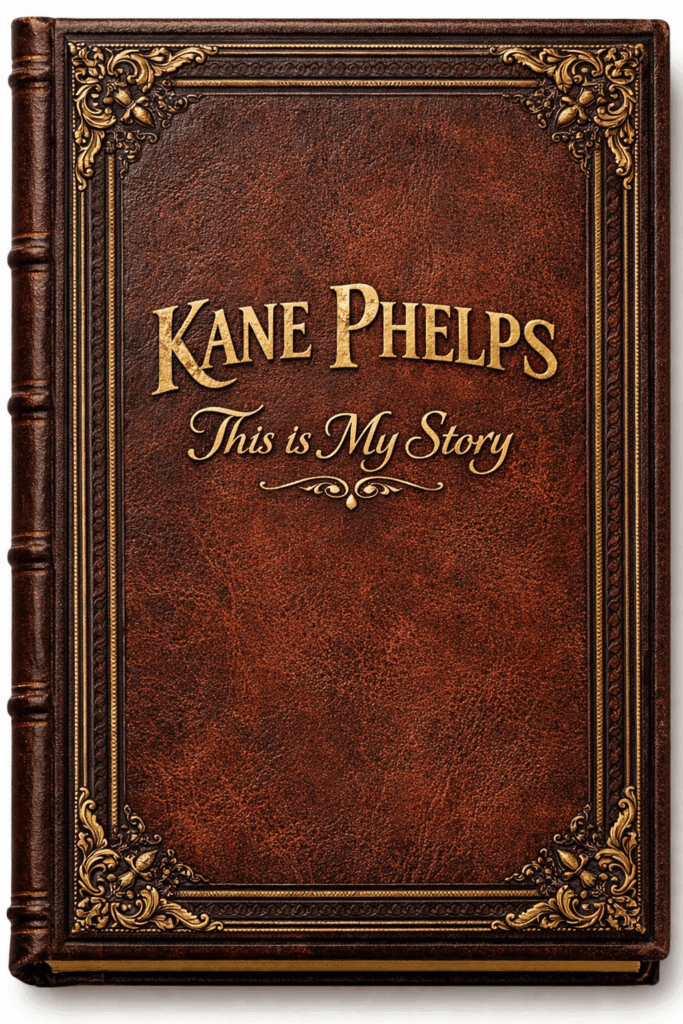
Ninth in an occasional series about stories and ideas worth telling.
You likely have never heard of Kane Phelps, and since he isn’t a celebrity, you likely never will. But Phelps has a story that is as compelling as any I’ve ever encountered, and it’s definitely worth my time.
I almost didn’t get to work with Phelps. He chose someone else as his first ghostwriter for hire, only to return a few months later, telling me that the person he was working with was less interested in ghostwriting than he thought.
Lucky me. This story covers everything that makes a story compelling: It has a powerful and irresistible effect; or earns admiration, attention or respect. It’s relatable, it has a wide swath of details that put the reader there (or makes the reader wish he or she was really there), and it evokes a wide range of emotions in a reader.
Finally, within the overarching story are little stories that, taken by themselves, are truly amazing, jaw-dropping, head-scratching, incredible, terrible, offensive, and unbelievable. Phelps must have really wowed people when he told them his various stories. Now, I have the honor of putting them all together into a cohesive narrative.
There isn’t enough space to tell all the amazing things that have happened to him, but here are some.
Phelps grew up an incredibly wealthy and privileged Rhode Island farm boy. His maternal grandfather was Nathan Miller, forty-third governor of New York. On his father’s side, he can trace his lineage all the way back to Richard Stockton, who signed the Declaration of Independence, and Gouverneur Morris, who wrote the Preamble to the United States Constitution.
The farmhouse in Portsmouth had a library with leather-bound works by Dickens and Shakespeare. There was a first edition of a portfolio of what was to become The Birds of America by John James Audubon. His father was friends with Ogden Nash, so they had a complete set of his works as well as a two-volume first edition of President Ulysses Grant’s memoirs.
With a family tradition (and accompanying wealth) like that, it’s no wonder that Phelps always felt his destiny was to be someone big, famous, significant, and important. He spent his life trying to find the way he would make it.
First, he wanted to be a famous baseball player like his idol, Mickey Mantle (yes, he was a Yankees fan in Red Sox country). But he was too small and uncoordinated. He tried football one year in high school and got a broken arm for this troubles. He went to debutante parties and stepped on girls’ toes while dancing. For most of his youth, he was sexually awkward.
He tried sidling up close to the school jocks and popular people in the hopes it would rub off on him. They thought he was like a gnat buzzing around them.
He had a contact that invited him to make movies in the Philippines, and he got there by riding a motorcycle that was way too big for him (he was compensating) from France to India by way of Greece, Istanbul, Syria, Baghdad, Tehran, Pakistan, the Taj Mahal, and Mumbai before catching a plan to Manila on the date John F. Kennedy was assassinated.
In the Philippines, Phelps met a childhood hero, Jock Mahoney, and a young Jack Nicholson, who befriended him for many years. He learned how to make movies and even appeared in two, “Back Door to Hell” and “Flight to Fury.”
He tried to make it in Hollywood and spent a lot of time with Nicholson pre-“Easy Rider.” He took acting and movement classes. He worked at the famed Fred C. Dobbs Cafe and Cinematheque 16 Theatre. He hung out at the Troubadour and Barney’s Beanery. He lived in Laurel Canyon during the late Sixties and had Chris Hillman of the Byrds as a neighbor. He attended a love-in at Griffith Park and one of Ken Kesey’s Acid Tests.
He tried making it as a stage actor at South Coast Repertory but found the politics of who got the best roles off-putting, so he opened his own theater and failed there, too.
He had a hippie first wedding and tried to start a commune that was a complete disaster. He met and married a famous singer (who he’s still married to fifty-one years later) and they made an album in 1978 that didn’t sell because it wasn’t a disco record.
Along the way, his alcoholic mother died at age 49 of a blood clot, and there were great missteps. He sexually assaulted the farm’s cook, joined a fraternity but quit after objecting to the intense hazing, tried to bed the town whore but left after becoming disgusted with the squalid conditions in which she lived, had an affair with a married woman that hurt his chances for an acting career in Hollywood, had a gay experience and found it gross, had bad trips on LSD, and was the odd man out in an orgy. His brother married the daughter of a Supreme Court justice, but his first wife got embarrassingly drunk at it.
Finally, Phelps discovered his ability to help people and became a therapist, and in his eighties he realized that he now was significant and big—to his clients. He had achieved exactly what he had set out to do, just not in the way he ever imagined.
And then, in a “Twilight Zone” sort of twist, he lost just about everything in the Palisades Fire. Yet Phelps is undaunted and knows that with what little time he has left, he can continue being important and significant to the people he serves.
We are almost finished telling his story, and it has been a very satisfying year together. Unfortunately, only his family will get to read it because he intended his story to be only for family.
They are lucky, and I am, too, for having gone on this journey with Kane Phelps.
Feel free to read and check out my other posts related to ghostwriting.
Let's Start A New Project Together
Contact me and we can explore how a ghostwriter or editor can benefit you.
