
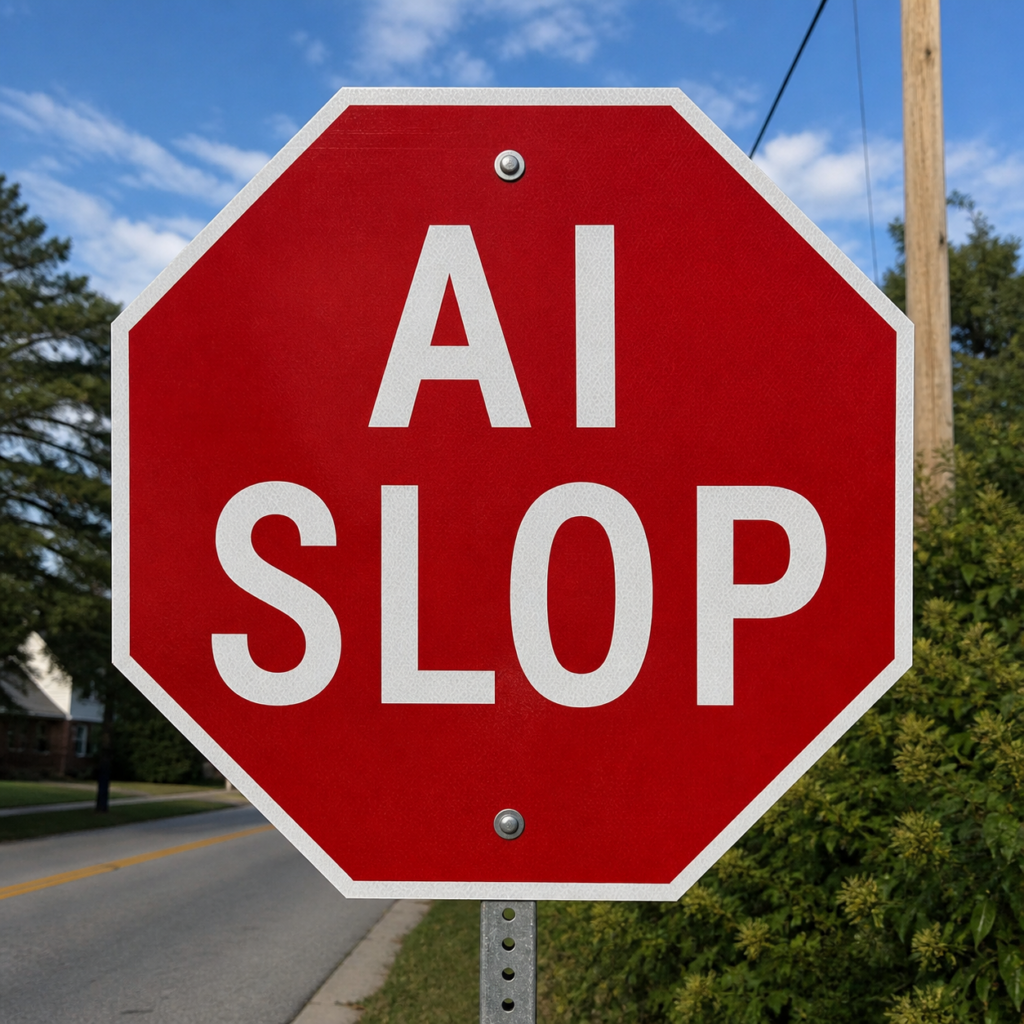
Today, I’m writing about AI slop. Similar to spam, it’s low-quality, high-volume copy (and images, though that’s not relevant here) AI creates to fill space, trick algorithms, clog the internet and monetize clicks rather than provide anything valuable.
Ghostwriters need to pay attention to this trend…because it can make them rich.
They are now being hired to either clean up and rewrite the generic AI-produced text. As James Carpenter told me, “(B)ecause of the highly imperfect nature of current LLMs, an AI-based writer like ChatGPT or Claude is arguably even more in need of a human … reading after it, to make sure it hasn’t introduced a lot of nonsense into the manuscript! (A lot of my job these days is fixing what AI writers do.)”
According to The Female Quotient Newsletter quoting Harvard Business Review, an employee having to fix another employee’s AI slop costs $186 a month. The bigger the company, the bigger the loss: A 10,000-employee company stands to lose $9 million in a year.
Perhaps worse, the HBR said, the slop is so bad that people see the employee as less intelligent, trustworthy, creative, capable, or reliable.
Carpenter said a client who wants to use AI “may just be introducing an unnecessary step into (the) process. … But if he wants to go ahead and do that, I’d say let him, and then see what shape you think the final product is in!”
Even if a ghostwriter isn’t hired to “clean up” the AI slop, a ghostwriter can still get rich because of the value he or she brings to the project. Plenty of people still want a human to write their book because they understand the intangible skills a human brings to the manuscript, so the ghostwriter for hire can charge a premium.
Here are five ways a ghostwriter can combat AI slop and provide real value to his or her clients:
1. Conduct deeper interviews than AI can. A human can sit with a client for a year and notice behavior patterns, inconsistencies, emotional tells, and stories that can be expanded from the little anecdotes the client tells. The ghostwriter has a toolbox filled with questions that begin with who, what, where, when, how, and why; AI doesn’t.
Here’s an inconsistency example: I had a client who married a psychopath. At first, she insisted she didn’t want to detail her sex life with him, and that made sense. Then she started talking openly about sex with him, to which I stopped her and said, “I thought we weren’t going to discuss your sex life.”
“When did I say that?” she asked.
I told her, “Months ago.”
“I don’t remember that,” she said. “I want it in.”
So we put it in and never discussed the matter again.
2. Keep the messes in. AI slop makes people flat and one-dimensional. Real people are messy and filled with contradictions, inconsistencies, and emotions. Great ghostwriters leave in the stuff that makes the characters human and adds to the story.
One client grew up in the Bronx and was exposed to gang life. He fell in with one, committed all kinds of crimes, got arrested, and went to jail and prison numerous times. But he also rescued a woman from a burning building, had a child out of wedlock that he has searched for decades to find but has failed.
Nobody is all good or all bad. Everybody is complex, and complexity creates credibility. AI slop can’t do that like humans can.
3. Capture a client’s voice and tone. AI slop can imitate cadence and copy grammar patterns, but a human can dig deep and discover a person’s humor, defensiveness, timing, emotional ups and down; favorite analogies, quotes, and metaphors. Then the ghostwriter can put into words how the client thinks, speaks, lives, behaves, and exists.
A current client believes that loyalty is paramount in a relationship, which is why at age fifty-three he has never been married. He saw his parents be loyal to each other, but the women he dates are fair-weathered, and he has no interest in matrimony with them. I’m telling stories that illustrate that; AI would simply state his philosophy.
4. Get more sources In my journalism days, I learned the importance of interviewing other people to flesh out the feature story about the person who overcame great adversity to excel. Getting input from family, friends, colleagues, critics, exes, or employees separates a human manuscript from one that’s AI-generated.
The same holds true for using documents such as letters, court records, journals, photographs, and published articles. They lend context and texture that AI can’t provide.
My wife-of-psychopath client spent a lot of time in court, and a publisher once said those records helped make that part of her story the most real and effective. I also interviewed her friends because it was important to show that my client was the last to know who she married. Her friends saw through him immediately, so the reader also knew immediately. That made for a more dramatic and emotional moment when my client finally discovered the truth.
5. Details, details, details. There’s a reason writers are taught, “show, don’t tell.” It’s more dramatic, visceral, and memorable to put the reader right there. That’s accomplished with sensory details.
That’s why one client’s suggestion his book begin with him witnessing a drive-by shooting when he was five years old was right. The reader hears the hustle and bustle of the city, sees the people sitting on their fire escapes, hears the salsa music and the conga drums, hears the gunshot, sees the man go down, hears a mother’s frantic screams, feels the dead man’s warm blood on his hands and clothes, and wonders why it happened.
AI summarizes. Human ghostwriters dramatize. People remember scenes, not summaries.
There is so much AI slop that there are so many more things a. Ghostwriter can do. More next week.
Feel free to read and check out my other posts related to ghostwriting. Go to https://leebarnathan.com/blog/
Let's Start A New Project Together
Contact me and we can explore how a ghostwriter or editor can benefit you.
